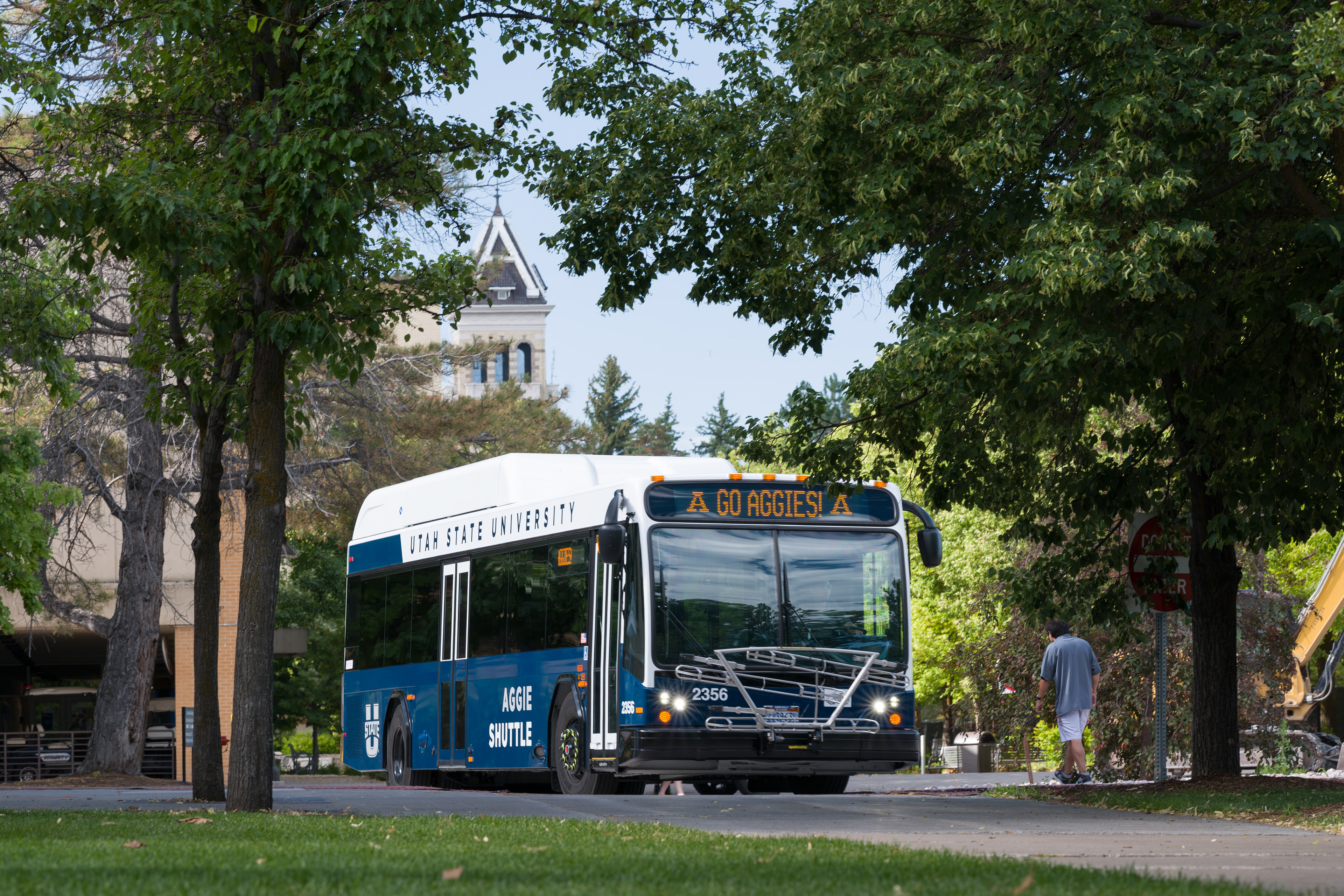
Courtesy of USU Photoshelter
I waited at the bus stop, squinting at my phone through the bright morning sun. I kept refreshing the Passio GO! app, which tracks Utah State University buses in real time. I wasn’t headed to campus—my goal was to catch the Silverline and meet the driver, Tom Reading.
I’d heard stories about the gregarious 78-year-old who’s been called “the nicest bus driver at USU.” I was curious and wanted to meet the local legend for myself.
A few minutes later, the Silverline bus arrived. I knew right away I’d found him. As the bus puffed to a stop, the folding glass doors revealed a smiling man in a blue-and-white Hawaiian T-shirt and a USU baseball cap. He greeted me with a kind smile as I stepped aboard.
Before I could say anything, another student struck up a conversation with Reading. They chatted as he turned a corner, accelerated and waved to a student walking on the sidewalk.
I glanced toward the back of the bus, surprised. Where you might expect to find people silently scrolling their phones, the bus was full of chatter, students were laughing and talking. Tim McGraw’s “Humble and Kind” played softly over the speakers, adding to the upbeat atmosphere.
Reading pressed the intercom and delivered the daily forecast. Then he paused, a grin spreading across his face.
“Ready for today’s dad jokes?” he asked.
“What do you call a weed that dresses as king of the jungle? A tumbleweed!
What do you call a worm that crosses over a ruler? An inchworm!”
As he delivered the punchline, Reading peeked at the large mirror above him to gauge reactions. He saw someone laughing and smiled. “I got a laugh out of that! Good job!” he said, fist-bumping the student.
As students exited, they shouted farewells: “Bye, Tom!” “See you, Tom!” “Thanks for the ride!” He responded to each by name. Everyone seemed to know Reading, and he seemed to know everyone.
I asked him how he remembered so many names.
“Everyone is creatures of habit,” he said. “They park there and hop on here. I say, come up and visit with me. I get to meet so many of them that way.”
As we talked, it was easy to picture a student standing where I was—leaning on the metal rail, chatting with the friendly, grandfatherly figure in the driver’s seat. Reading was kind and easy to talk to. I could see why so many students loved him.
Driving through a parking lot, Reading slowed to allow a young woman on crutches to board.
He said to me, "She just found out she broke her leg,” he said. “She thought it was a torn ligament. She had an MRI last week. Turns out the top of her femur is cracked. They told her to just be careful for a while.”
I was surprised he knew so much about her. She only rode the bus for five minutes a day. But I soon realized that Reading surpasses small talk. He asks students genuine questions, and by doing so, learns their stories and struggles.
“These kids are so stressed sometimes,” he said. “They need someone to say hi and smile. I get notes from students that say, ‘You’re the first friend I found at Utah State.’ I pick them up for four years and then they graduate. They send me invitations to their wedding.”
Gesturing toward the stadium, he added, “I became friends with the athletics teams too. My wife and I crocheted six-foot-long scarves for the entire gymnastics team and invited them over for dinner.”
Despite his age, Reading is a focused and capable driver. He’s alert—but has to watch out for “crazy, strange things,” like people stepping in front of the bus without looking.
Later, I watched him bend down and wrestle out the straps to secure a motorized wheelchair to the bus floor, moving with the agility of someone half his age.
“In my opinion, if you don’t stay active, you die,” he said. “You gotta walk. You gotta hike.”
Reading enjoys gardening with his wife, golfing and playing basketball with “young guys that are 70.”
He’s lived a full life.
As we drove, Reading recounted stories of avalanche survival, missionary work in the Middle East and adventures in Hawaii.
He was born in Logan, Utah and graduated from Utah State in 1972. He worked with a construction company to help build the Spectrum arena and worked as handyman at the Alta Peruvian Lodge. At 27, he met his wife. Five months later, they were married.
He became a seminary and institute teacher, eventually spending 37 years in the role. Though he loved it, the meager pay required him to take on a second job building skylights. When he retired from teaching, he began driving buses. “I thought, a part-time job—that’s something to do 20 to 25 hours a week,” he said.
For all his stories, his life hasn’t been without hardship. Several years ago, his wife battled cancer and chemotherapy. Last September, he was hospitalized for kidney stones.
Yet he shows up to work, often by 6 a.m. smiling. His effort to connect goes far beyond a forced smile or polite “good morning.”
“Tom makes an effort to get to know individual people and make them feel like they had a friend they saw that day. I think that’s really sweet," Olivia Phillips, a Silverline bus rider said. Asher Johnston, another morning passenger, echoed this sentiment saying, “He’s the best! I love Tom."
Even though he drives in a loop, it’s clear he’s getting somewhere with his passengers.
As we reached my final stop, I thanked Reading for the interview. As I turned to go, he asked me to repeat my name.
“Jane,” he paused. “Jane.”
I smiled. I knew he’d remember it.